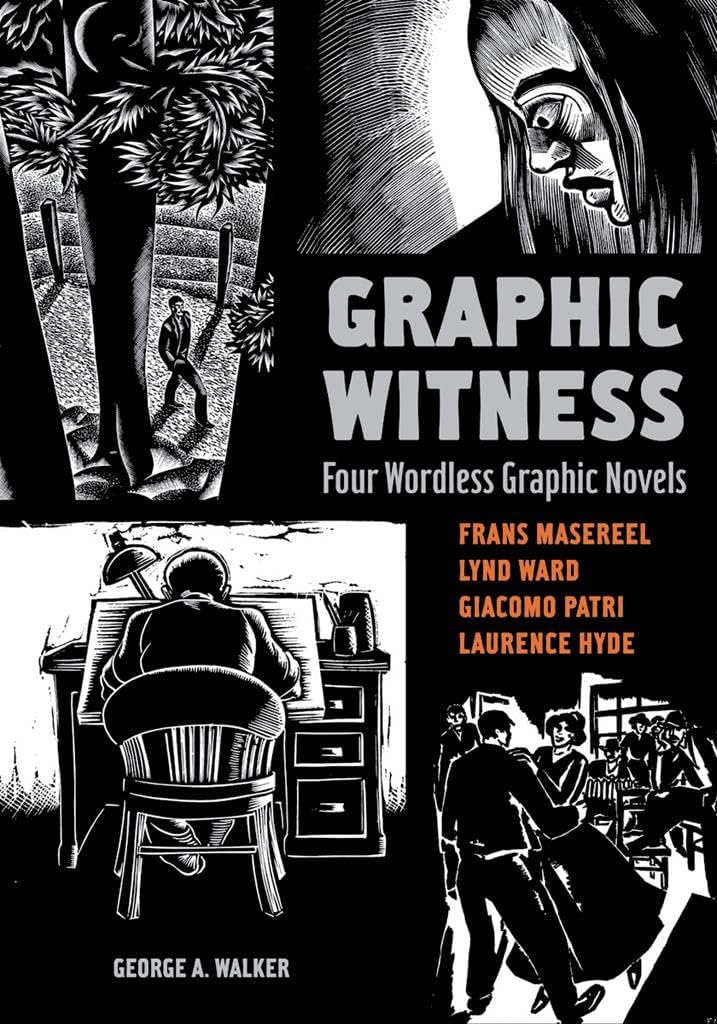
Graphic Witness: Four Wordless Graphic Novels by Frans Masereel, Lynd Ward, Giacomo Patri and Laurence Hyde
Product ID: 4162955
Buy anything from 5,000+ international stores. One checkout price. No surprise fees. Join 2M+ shoppers on Desertcart.
Desertcart purchases this item on your behalf and handles shipping, customs, and support to Greenland.
Graphic Witness: Four Wordless Graphic Novels by Frans Masereel, Lynd Ward, Giacomo Patri and Laurence Hyde [Masereel, Frans, Ward, Lynd, Patri, Giacomo, Hyde, Laurence, Walker, George A.] on desertcart.com. *FREE* shipping on qualifying offers. Graphic Witness: Four Wordless Graphic Novels by Frans Masereel, Lynd Ward, Giacomo Patri and Laurence Hyde Review: Great!!! - Gorgeous book with detailed explanations of woodcut techniques including pictures of the tools and how they are used. The wordless novels are amazing and you can see the similar yet totally individual styles of these 4 artists. Review: Impressive artistry! - Four stories- no words- let your mind connect the dots. Amazing amount of thought, planning, and work that the artists put into these four different stories.
| Best Sellers Rank | #1,486,651 in Books ( See Top 100 in Books ) #1,634 in Educational & Nonfiction Graphic Novels #1,827 in Literary Graphic Novels (Books) #32,746 in World History (Books) |
| Customer Reviews | 4.9 out of 5 stars 46 Reviews |
P**R
Great!!!
Gorgeous book with detailed explanations of woodcut techniques including pictures of the tools and how they are used. The wordless novels are amazing and you can see the similar yet totally individual styles of these 4 artists.
B**E
Impressive artistry!
Four stories- no words- let your mind connect the dots. Amazing amount of thought, planning, and work that the artists put into these four different stories.
A**V
Enjoyed it!
A mew art form for me!! Enjoyed it!!
L**V
Graphic Witness
My son bought Graphic Witness: Four Wordless Graphic Novels for one of his college classes. It served it's purpose for his class.
R**R
Not only for print lovers
Wonderful. Matchless. So entertaining, and important for print lovers.
J**Y
Pure Gold in Black and White
As a long-time collector of woodcut novels, I am overjoyed to see the republishing of these gems. In this one very reasonably priced volume, you get a great introduction to this little known art form. If you have an interest in art history, early-to-mid 20th century political movements, art deco style, or if you simply enjoy good stories, you'll love this book. You really do not need an interest in modern-day graphic novels to appreciate these works (I don't). If you do have an interest in graphic novels, get this book, and learn some family history of the art. Each of these books (four books for the price of one!) takes a slice of the artist's contemporary life and then explores the timeless conditions of humankind. Masereel was profounding affected by World War I and the European chaos between the wars, so his art addresses social conditions, including the urbanization of society, during those years. Ward and Patri were also affected by their times -- so the hardship and civil unrest brought on by the Great Depression and the trade union movement is the background for their stories here. Ward also presciently treats the rise of nazism in his other woodcut novels. Patri's "White Collar" in particular is a real find, because this story is not readily available in any other form, as far as I know. Finally, Hyde's story was printed in 1951, and he addresses the first man-made weapon of mass destruction, the A-bomb, and its effect on the environment of the South Seas. This book also gives a good sampling of the art of the woodcut novel, over time. The earliest is Masereel's work of 1918, and his figures have the least detail, and thus lack an ability to communicate nuance in the characters. Ward's work, is highly detailed, in a distinctive art deco style (akin to the work of Rockwell Kent) and I find more enjoyable. To fully appreciate all these works, you need to spend some time with them on a second and third "read." It takes only a few minutes to go through each story, which is all it takes to get a general understanding of the story. However, upon rereading, and studying the figures, you will probably come to a different understanding of the story. Without words, there is a lack of precision, so your life experience and imagination will fill in the blanks. Congratulations to the publisher (Firefly Books) for preserving this important art form, and making it accessible at a very reasonable price. Kudos!
L**S
Four Early Graphic Novels
An excellent introduction to early graphic novels. First, the publisher has not stinted on the production of the book. Thick paper stock was used, the page size is large and the paperback was sown, not glued. There is also a helpful introduction by George Walker. The four complete novels included in this volume are wordless graphic novels created using various relief-printing techniques. Mr. Walker provides information on the four novelists, but more importantly explains the printing techniques used by each novelist, including the tool used to make the various types of engravings. The feel of each novel is quite distinct from the others, and by providing the reader with a short technical background of the various techniques used, the reader can appreciate not only the novels themselves, but also the stylistic quirks and strengths of each book. I thought the storyline of Laurence Hyde's Southern Cross was simplistic and uninteresting, but the individual engravings were fascinating. My favorite wordless graphic novel author is Lynd Ward, and his Wild Pilgrimage is included. I have this as part of the Library of America Lynd set, but I was happy to have it included in this much larger format with considerably better paper. The other two novels included are Frans Masereel's The Passion of a Man and Giacomo Patri's White Collar. Patri was the only artist whose work I was unfamiliar with, and the storyline of his book is by far the strongest of the four. A haunting reminder that the gap between middle class and homelessness is often only as wide as one bout of bad luck.
W**D
What relief
These four graphic novels cover a range of relief printmaking techniques: woodcut, linocut, and wood engraving. They cover a range of styles, as well: Masereel's Expressionism, Ward's delicate linework on bold figures, Patri's crisp realism, Hyde's detailed primitivism. And, although they cover very different eras and stories, they all end in pessimism about people's treatement of people. Masereel's story is the most ambiguous. His imagery has least in the way of explicit continuity and the most in dramatic contrasts. Masereel makes it clear, however, that the urban world has dozens of ways to chew people up and spit them out. Ward's "Wild Pilgrimage" tries to escape an urban hell, but finds rural America is no better. It includes a lynching early on, an ugly blot from the country's not-so-distant past. Patri's "White Collar" conveys the hopeless of The Depression, a world where no amount of hard work can be enough to make ends meet. Finally, Hyde's "Souther Cross" brings us up to the atomic age, examining one of the human costs of 50s-era nuclear testing in the Pacific. Walker's collection reminds us that the graphic novel, as we know it today, drew from many sources. On one hand, comic strip culture evolved upwards through generations of comics towards today's graphic novels, and now presents very mature works by contemporary writers. In the other direction, fine art printing found itself too constrained by the single image. It needed plots, not just snapshots. As a result, it's easy for today's reader to appreciate these moving graphic series - and maybe easier, when that reader learns about the persecutions and McCarthy-eras black-balling of some of these artists and their works. -- wiredweird
Trustpilot
4 days ago
2 weeks ago